

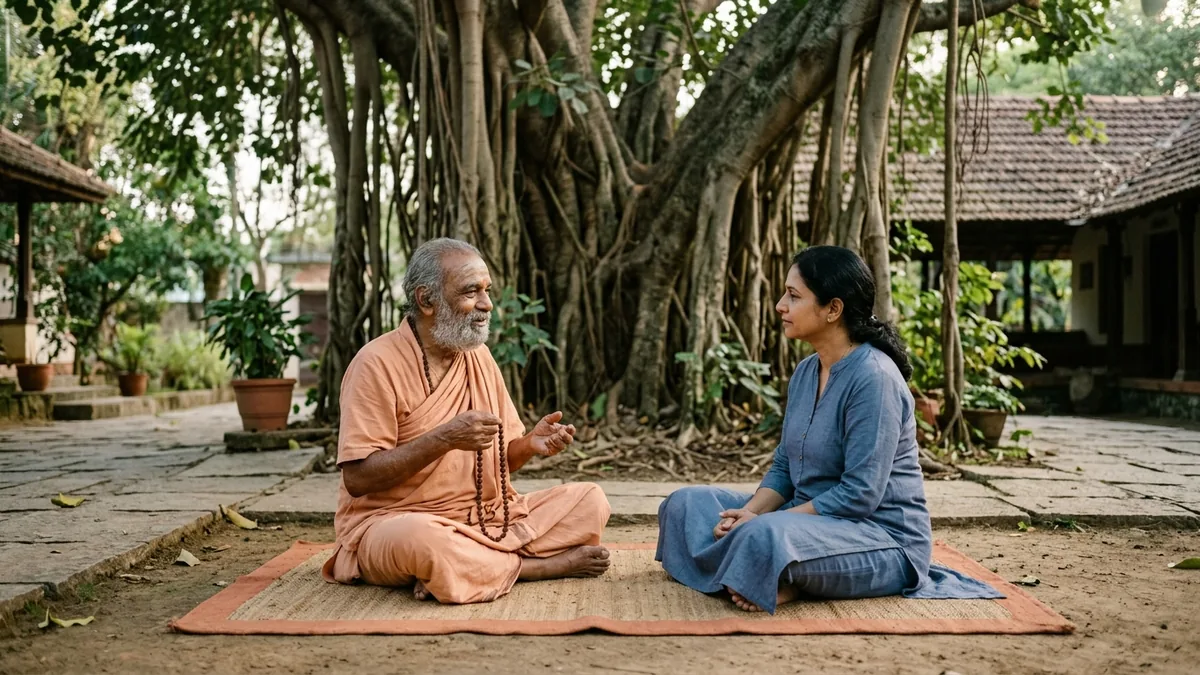
The grey-bearded old man took his time before answering. He had once been a multimillionaire. Then he gave it all up and became a sanyasi.
I was curious about both halves of that story: how he had made so much money, and why he had walked away from it. So I asked him the simplest question I could think of. How do we make money in life?
In giving, you shall receive.
He looked into my eyes and said, "In giving, you shall receive."
I must have looked disappointed. "Yes, yes," I said. "People say that all the time."
"No," he said. "Listen carefully. If you give ₹10, you will receive ₹100. But the ₹100 may not come to you as cash. It may come as an opportunity, a contact, a situation, a set of circumstances that turn in your favour so that you can earn that money. Extend the pattern. Give ₹100, and you will receive ₹1,000. Give ₹10,000, and you will receive ₹1 lakh. Whatever you give comes back to you as opportunities, links and the right people at the right time. Once you understand this principle, making money becomes easier."
The more people you care for, the more you receive.
There was a corollary, he said. The money you make grows with the number of people you take care of, or the number of people who benefit from what you offer. If a hundred people benefit from your product, you will do well. If a thousand benefit, you will do better, and if ten thousand benefit, better still. "Remember this," he said. "Benefit a great many people, and making money becomes very easy."
The same law works at home. People often find money coming faster after marriage, he explained, because marriage brings a balance of yin and yang, and because you begin to take care of another person. When children arrive, the circle of people you care for grows again, and so does your capacity to earn.
Marriage is not the only door. I know women who never married and yet did remarkably well because they devoted themselves to caring for their parents. One friend of mine who never married became very successful in her career, and I have always believed that her care for her parents had much to do with it.
Give with understanding.
"Should we give in random amounts," I asked, "or is there a technique to it?"
"There is," he replied. "Use the law of opposites. When a man gives to a woman, or a woman gives to a man, the money manifests faster. Women naturally give to younger people, and in small portions. For a woman to make money, she should also give to elders, and give generously, in bulk. For a man, it is the reverse. He should give to women and to the young, in small, regular amounts rather than in bulk."
He described a second pattern too. A man's wealth grows when he gives for happy occasions: a wedding, the birth of a child, building a house, buying a car, travel or education. A woman's grows when she gives in times of trouble, such as a death or an illness in a family.
Then he smiled. "But don't make it complicated. Give whenever an opportunity comes, and you will grow." And give close to home, he added. A man who looks after his wife's family, his siblings' families and his own parents will prosper. So will a woman who cares for her in-laws and for her own brothers and sisters.
What about hard work and education?
As he spoke, several examples from my own life flashed through my mind, and each one fitted his principle. Still, I was surprised. I had expected him to talk about financial management, or about the familiar virtues of hard work, perseverance and education. I asked him why he had left them out.
"At one level, education helps a great deal," he said. "At one level, your background helps. Hard work, honesty and contacts all help. But if you want to make big money, you must understand the principle of giving and receiving. That is what makes it easy."
It made me think of the books so many of us grew up on, such as Norman Vincent Peale's The Power of Positive Thinking and Napoleon Hill's Think and Grow Rich, with their emphasis on attitude, persistence and learning. Valuable as they are, the principle of giving and receiving goes deeper. Perhaps that is why many self-made millionaires had little formal education. What they understood was how to give.
"How do I take care of people?" I asked.
"Look at it this way," he said. "You have employees, investors, family members and customers. Take care of all of them with the attitude 'first I give, then I receive,' and money will come to you far more easily."
And planning? It helps, he said, up to a point. But the deeper you go into life, the more you find that links, coincidences, opportunities and meetings with the right people cannot be planned. They come to those who give first and serve first.
Why he gave it all away.
I could no longer hold back the question that had brought me to him. "You gave up all your wealth for other people and took sanyasa. Why?"
"Earlier, I gave objects and money," he said. "Now I give energy: positive, meditative energy, channelled into the world from the antahkarana, the inner instrument of the mind." It was still giving, he explained. Only the currency had changed.
"Do we need to trust God?" I asked.
"Trust the principle of karma," he said. "What you give comes back to you, sooner or later. Give good things, give money, give happiness, and they all come back." People lose sight of this simple principle in a maze of techniques, he added, and so they never grasp the real power of manifestation.
What about creative visualisation, which so many books on manifesting money recommend? It helps sometimes, he said. But when you give, even without visualising anything and without fully understanding how it works, the links, coincidences and opportunities arrive on their own, and the money follows.
Whom not to take money from.
"Is there anyone we should not take money from?" I asked.
"Generally, a man should not take money from women, especially elderly women," he replied. "And be careful about taking money from your own people: your father, mother, brothers and sisters. Take money from your own people, and you will be forced to spend it on outsiders. If you want to make a lot of money, take money from the outside world, from people you do not know, and give it to your own people. Do the opposite, and the money will leave you."
I thought at once of a woman I know who started a business with money borrowed from her father and her brother. It did very badly. Now I understood why. I also thought of an actor I know who took care of his three brothers. He arranged their marriages, found them jobs and bought them homes, and he went on to become a very successful actor.
Think in villages, not individuals.
"If you want to become a crorepati," the old man went on, "take care of villages. Take care of a great many people." The truly successful, he said, look for chances to donate on a large scale, because they know the money returns to them as opportunity.
I could not help thinking of the Telugu star Mahesh Babu. He is reported to give around ₹25 to 30 crore a year to social causes. His foundation has funded more than 4,500 free heart surgeries for children, and he has adopted two villages, Burripalem in Andhra Pradesh and Siddapuram in Telangana, supporting schools, hospitals and other facilities there.
The old man took a sip of water and continued. "There is a hook," he said. "The hook is that people depend on you, and your money means a great deal in their lives. When you help people with their problems, their needs and their difficulties, money manifests very easily. The more hooks, the more money. Look at any big organisation. So many people depend on it, and it makes a great deal of money. If a country takes care of its people well and uses its taxes wisely, it too becomes abundant."
Why isn't India richer?
"Then why," I asked, "does a country with as many people as India struggle to create abundance for them?"
"The political system is skewed," he said. "You cannot expect people to work for free. If you hired a chief executive to manage thousands of crores, you would pay him very well. In the same way, India's MLAs and MPs should be paid in crores. When they are paid poorly, they take money from the system itself. We call it corruption. They call it recovering what they spent on elections and party funds."
He pointed to Singapore, whose ministers are among the highest-paid government officials in the world. India's President, by contrast, earns ₹5 lakh a month. "Who would run an enterprise of this size for that?" he asked.
His second point was about competence. "Look at the country as an enterprise," he said. "Whether people are elected or selected, those who govern should be qualified, and qualification should come first. Being born into a particular caste, colour or creed does nothing for the country. Yet ministers are too often chosen for their caste or their region rather than their ability."
"Why don't IAS and IPS officers make up for it?" I asked.
He smiled. "Where the head moves, the whole body follows. If the head of a department is not educated, it shows in the entire system, just as children tend to do better when their parents are educated. You cannot expect an IAS officer to perform well when he has to take orders from someone who is not qualified."
Invest for decades, not days.
"What should I invest in?" I asked. "Gold, land or stocks?"
"Whatever you invest in, think in terms of fifteen to twenty years," he said. "Over that span, almost everything gives a return." People lose money in stocks, he explained, because stocks are so easy to buy and sell, and their constant ups and downs disturb the mind. Gold or silver held for fifteen to twenty years, in his view, generally proves profitable. A rare few develop the skill to make money in the short term, but for most people he advised playing the long game.
What really makes people lose money, he said, is stinginess: being tight-fisted, overly cautious and unwilling to give. I have seen it myself in people who do not want to take care of their parents or their children; their opportunities keep shrinking. Karma works through the mind. When the mind becomes closed and narrow, perception suffers, and that is where karma takes hold.
"The best investment," he said, "is to give money to others and to take care of others. Live by the Bodhisattva principle: try to give more than you receive. Your life will become not only peaceful but also very successful."
Then he rose and began to walk away. "We will talk about the other aspects of money another day," he said. "Take care."
Two ways to wealth.
In the years since that conversation, I have kept watching how money moves through people's lives, and I have found his principle running through all of it.
Broadly, there are two ways to make money. The sattvic way is to benefit others and be benefited in return; most honest business, farming and service work follows this path. The tamasic way is to profit from harming others: drug smuggling, murder for hire, corrupt politics, the destruction of whole peoples and the plunder of colonies. The near-extermination of Native Americans and the exploitation of colonies in Southeast Asia and elsewhere enriched the powers that carried them out.
Both ways produce wealth. But money made the sattvic way tends to stay longer, and it brings peace with it. Money made the tamasic way is eventually caught by the law of karma. Over time it shrinks or fades away, or its owners find they cannot enjoy it. Islam has a word for such earnings: haram, money gained through evil or by harming the lives of others. The sattvic way makes money by making life more peaceful, happy and harmonious, and by freeing people from suffering, as new medicines do, or as everyday machines like the washing machine and the grinder have done.
The yin and yang of earning.
There is another way to look at it. In the yin, or feminine, way of making money, a person gives energy and support to others and is cared for in return. This way centres on relationships and on nurturing the next generation: education, food, a well-run home. In the yang, or masculine, way, a person goes out to work and uses the money earned to protect and provide for the family. Neither way is higher or lower. But if your aim is to make a great deal of money, the yin way alone will not get you there.
Consider, though, what the yin way is worth. If a middle-class family had to pay for all the cooking, cutting, cleaning, washing, sweeping and mopping that a woman does at home, it would cost at least half of the household's salary. She keeps the home in order and charges nothing for it. That, too, is a way of creating wealth. Today, technology and better support systems have made home life far easier. Once a child is three to five years old, many women are relatively free to earn, and the internet, modern appliances and work from home have opened many new doors.
One principle behind every path.
There are many models of making money. Farmers grow essential grains and trade them. Businesses exchange goods and services for money. Professionals sell their knowledge and expertise as consultants and service providers. And there is the protection model, the king's way, in which armed forces guard a nation's borders and its people.
None of these is better or worse than the others. All of them turn on a single pivot: what you give, you receive. Give knowledge, and knowledge comes back to you. Give power, and power returns. Give money, and money flows back. Give love, and you receive love. Give understanding, and you will be understood. This is the law of karma, and it rests on the principle of oneness. We look separate, but that separateness is an illusion, and the suffering or joy we cause another eventually finds its way back to us. What goes around comes around.
Let your objects work for you.
Look at money as energy, and at objects as energy too, and much becomes clear. I have noticed that people whose careers are stuck often carry a cracked phone or a laptop that barely works. When our energy is blocked, it shows up in broken things, and broken things in turn keep money from flowing freely. Objects mirror our unconscious. A troubled marriage often shows itself in the bed a couple shares, and a struggle with weight may call for a fresh look at the kitchen and the vessels we eat from.
There are two ways to work with objects: let go of the old, and bring in the new. Many of us cling to old things out of memory and attachment. I have seen homes full of clocks that no longer run and clothes that have not been worn for years, all kept for sentimental reasons. Open almost any wardrobe and you will find things that are never used.
But what about museums and exhibitions, I once wondered, which are full of old objects? The rule is simple: an object should be used, kept clean and kept visible. Follow these three principles and you can keep anything. Museum pieces are cleaned, displayed and seen. The forgotten things in our cupboards are none of these. They gather dust and take up space.
Upgrading your objects upgrades your life, because good equipment buys back your time. A washing machine finishes the laundry while you do something else. A wet grinder gives you plenty of batter and leaves you time to spare. That time can be put to productive use. This is what luxury really means: the ability to buy back time. A wealthy woman who does not have to cook, clean, wash the vessels or do the laundry has hours left over to take care of herself.
But buy for use, not for show. Many people buy an iPhone or a Mercedes-Benz to impress others. Before you buy anything, ask yourself whether you will use it again and again. I have seen artists buy the latest equipment so that their work flows more easily, and that is money well spent. Things bought to show off soon become boring and lie unused. Things that serve you every day keep bringing you happiness.
Live where abundance lives.
The places we live in matter as much as the things we keep. One of the most important principles of abundance is a clean home. As the saying goes, cleanliness is next to godliness. Think of why five-star hotels can charge so much: they offer luxury, yes, but above all they keep every corner clean, bright and orderly. A clean, airy, sunlit home invites wealth in. A dark, damp, neglected one keeps it out.
Where you live matters too. Wealth gathers where wealth already is; birds of a feather flock together. If you live in Chennai, aim for a neighbourhood like Adyar or Boat Club Road. In Hyderabad, aim for Banjara Hills. Surround yourself with people who are growing, and their energy and opportunities begin to reach you. Stretch for the best place you can manage. The rent may feel heavy and the surroundings unfamiliar at first, but you will adapt, and in time you will grow into the place.
Finally, do not stay in one house for too long. After three to five years, the energy of a home tends to stagnate, and its people settle into a fixed routine and a fixed frequency. Even the great Tibetan yogi Milarepa practised in many caves and mountain retreats rather than one. If you want growth, keep moving up: upgrade your home every few years, and you open the door to new wealth and new opportunities.
Choose your circle.
Most successful people have mentors, and very few friends. A good mentor lifts your energy, helps it evolve and raises it to a higher level.
Now look honestly at your friends. How many of them are richer than you, wiser than you or further along than you? In time, you will become like the people you spend your days with. Many of us choose friends who keep us comfortable rather than friends who stretch us.
I once met a man whose career was in trouble. I told him he probably had a friend whose career was in trouble too, and he agreed. I have seen people with struggling businesses spending their time with others whose businesses were struggling, and people with troubled marriages surrounded by friends whose marriages were troubled. Like attracts like. To break the pattern, spend time with people who are doing better than you, and your own life will begin to rise.
This is why so many people who make a lot of money come from good schools, where they are surrounded by others who want to succeed, evolve and improve. It is why a winning political party tends to keep winning: success attracts successful people. And it is why so many of life's problems begin with the wrong relationships.
The same applies to marriage. Marry someone who lifts you, from a family that can open doors you could not open alone, and your energy will grow with theirs. Old-school networks and clubs work on exactly this principle: people rise together because they come from the same place.
I often think back to that conversation, and to the old man's first words, the ones I almost dismissed as a cliché. In giving, you shall receive. Everything else he told me, and everything I have observed since, grows out of that one sentence.
So start where you are. Give a little more than you take, at work and at home. Care for more people, and let more people benefit from what you do. Keep your home clean and your things useful, choose your company with care, and invest for the long run. Above all, give first. The opportunities, the links and the right people will find their way to you, and the money will follow.
Related Articles

Mind of a Champion
The habits of mind that set champions like Ilaiyaraaja, Vadivelu, A.R. Rahman, Rajinikanth and Novak Djokovic apart.
Life Events & Prosperity Cycle
Why weddings, children and celebrations open doors of abundance, and how to align with life's cycles.
Ancestor Traditions & Dissolution
How world traditions care for their dead, teachings of pralaya, and perspectives on time.