

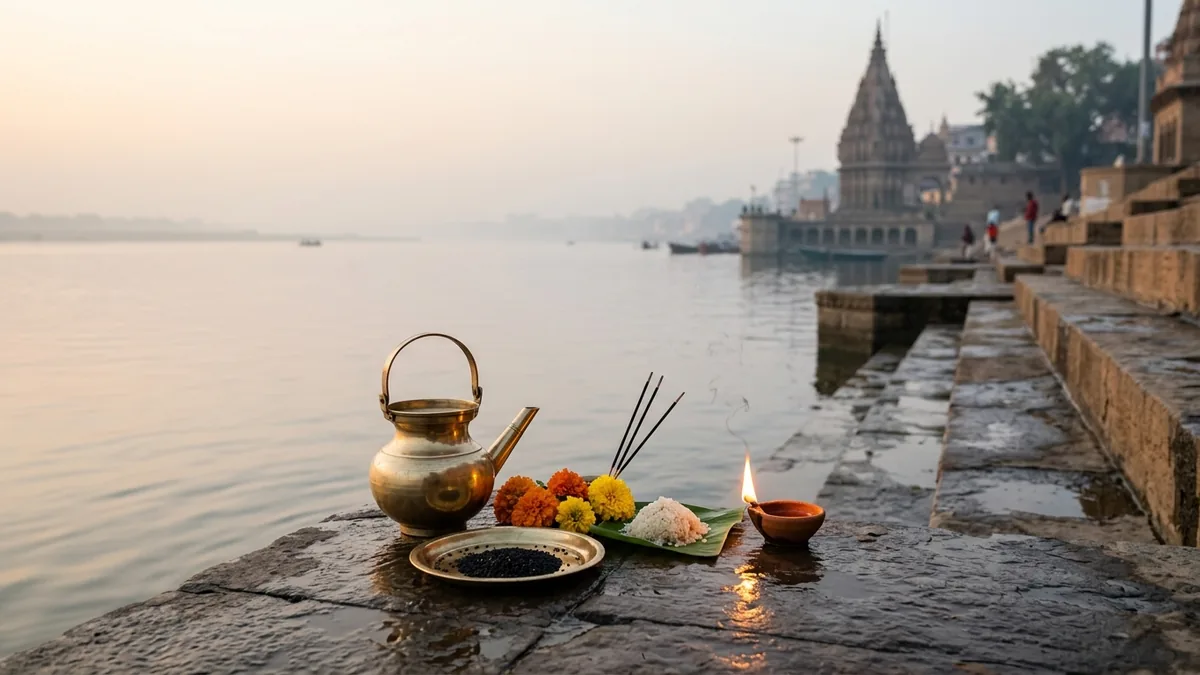
Every culture finds a way to remember its dead. Christians set aside All Souls' Day to pray for the departed. Many African traditions, including West African Vodun, keep the ancestors close through ritual and offering. In Chinese homes shaped by Taoist and Confucian thought, ancestors are honoured at family altars, and their graves are swept and tended each spring.
Of all these traditions, I believe the most fully developed is the Hindu practice of tarpanam and shraddha: offerings of water, sesame and food to the ancestors, made with precise mantras at precise times of the year.
The ancestors do not disappear.
Hindu tradition rests on a few simple beliefs about those who have gone before us. The ancestors do not die and vanish. They move into a subtle realm, often called the astral world. There they still feel something like hunger and thirst, though not in the way we do, and we can reach them through ritual. Offering water quenches their thirst, and offering food satisfies their hunger. They do not eat with a physical body. They take in the energy of the offering through sight and sound, which is why the mantras are chanted aloud.
The rites traditionally reach back three generations: father, grandfather and great-grandfather. The eldest son has long been the one entitled to perform the full ritual, though today more and more women are breaking with custom and performing it themselves.
A calendar for the ancestors.
The offerings follow the rhythm of the heavens. The six months when the sun travels from Karkataka (Cancer) to Dhanus (Sagittarius), known as Dakshinayana, are considered especially important, and it is the season of the great collective offerings. Every Amavasya, the new moon, along with certain other tithis, is set aside for tarpanam. Two seasons stand out above the rest. One is Mahalaya Paksha, the fortnight of the ancestors, which falls around September and October. The other is the month from mid-July to mid-August, which includes Aadi Amavasya. Tarpanam is also offered at the junctions of time: the turn of the sun's half-year (ayana sandhi), the turn of each lunar fortnight (paksha sandhi) and the turn of each month (masa sandhi).
The ritual itself is precise. It begins with a sankalpa, a formal statement of intent. The sacred thread, normally worn over the left shoulder, is shifted to the right for the rite, reversing its usual direction. Black sesame seeds are mixed with the water, for sesame is believed to carry the energy of the offering to the ancestors.
Many ways to feed the ancestors.
Not every family follows the full Vedic rite. In many Tamil homes, the ancestors are honoured with padayal: their favourite dishes are cooked and laid out before their pictures, offered with love and then shared among the family. Simpler in form, it rests on the same belief that the departed still receive what we offer.
Tradition also holds that a lineage can carry unrest. When ancestors have died untimely or violent deaths, including by suicide, or when their rites have been neglected, their souls are believed to remain unsettled, and the family may feel that unrest for generations. This affliction is known as pitru dosha, or pitru shapa, the ancestors' curse. For it there is a specific ritual, the tila homa, a fire offering of sesame performed to release the ancestors from the twenty-eight narakas, the realms of suffering described in the Puranas.
Astrologers read such afflictions in the horoscope, in combinations of Ketu with the Sun, which signifies the father; with the Moon, which signifies the mother; or with Mars. The Puranas, the Garuda Purana above all, describe the rites after death in remarkable detail. Few traditions anywhere have mapped the journey of the departed so carefully.
The Tibetan way.
Tibetan Buddhism has developed its own profound teachings on death. The best known is the Bardo Thödol, often called the Tibetan Book of the Dead. Tradition attributes it to Padmasambhava in the eighth century; it was hidden and later rediscovered in the fourteenth century by the treasure-revealer Karma Lingpa. The text guides the consciousness through the bardo, the intermediate state between death and rebirth.
Alongside it stands the practice of Chöd, developed by the great yogini Machig Labdrön. In Chöd, the practitioner visualises offering his or her own body as a feast for spirits and demons, and in doing so cuts through the clinging to self. Both are valid paths, and both have been refined to a remarkable degree.
Everything that is born must dissolve.
If the ancestor traditions teach us how to care for those who die, the teaching of pralaya reminds us that dissolution awaits everything, not only individuals. In my understanding, there are four ways in which humanity itself could be dissolved, one for each of four elements.
The first is through earth: the ground opens and swallows human beings in a cataclysmic earthquake. The second is through water: the seas rise and cover the land, as in the great flood of the Bible and the flood that Manu survived in the Hindu story of Matsya. The third is through fire: the heat of the sun grows so fierce that it scorches life from the face of the Earth. Astronomers, too, expect the Sun to swell into a red giant in about five billion years. The fourth is through air: the atmosphere becomes so toxic that breathing is impossible, and it reacts with and dissolves the water within our bodies.
From planets to the universe.
Dissolution does not stop with humanity. Planets dissolve. Solar systems dissolve. Stars and whole galaxies dissolve. The final Maha Pralaya is the dissolution of the entire universe. Picture it as a ladder: the human being, the planet, the planetary system, the star, the galaxy and, at last, the universe itself. These timelines lie far beyond ordinary human understanding.
In meditation, I have seen this process as a play of black holes and white holes. The black hole draws in the life essence and consumes it. The white hole releases life essence and gives birth to new worlds, like a baby planet that grows into something vast. At the end of every black hole there is a white hole, and at the end of every white hole a black hole. At the level of energy, this dissolution and creation can happen even without physical black holes and white holes.
I should be honest about the nature of this vision. Physicists regard white holes only as a theoretical possibility, and what I describe here was seen clairvoyantly, not established with scientific rigour. But one truth needs no proof at all: everything that is born will one day die. That is the greatest understanding we can hold.
The turning of the yugas.
Throughout history, people have died in great numbers through war, natural calamity and epidemic disease. Yet humanity as a whole has never been wiped out. That, the tradition teaches, will come only at the turning of the great ages, when the Kali Yuga ends and the Satya Yuga begins. In Western terms, the four yugas are the iron, bronze, silver and golden ages.
These timelines are beyond the reach of ordinary minds. Even the greatest scientists, an Einstein or a Newton, could not calculate them with mathematical models. The rishis understood them in another way, through drishti, the direct seeing that comes with the opening of the third eye. To grasp the full bandwidth of time, one must see rather than calculate.
Time has two speeds.
Daniel Kahneman's book Thinking, Fast and Slow describes two speeds of thinking. Time, too, has two speeds. When we suffer, time slows down; in the lower astral realms, pain and suffering are said to stretch out for what feels like an endless period. When we are happy and joyful, time speeds up and flies past. Time moves slowly or quickly according to the state of our consciousness.
The film The Matrix captures this beautifully. As Neo awakens, he learns to see the world in slow motion, watching bullets crawl through the air. Time and mind are bound together. When the mind contracts in pain, time slows. When the mind is light and joyful, time races.
Death places us in yet another dimension of time and space. We no longer need food or sleep in the physical sense, because the physical body has dissolved. We live on in the mental body, which still has a shape and a size, in what we call the astral world. Death dissolves the elements of earth and water, while fire, air and ether remain. And in the realms of suffering after death, five minutes can feel like an eternity.
Time as an octave.
Time also runs on different scales in different realms. A single day of Brahma, called a kalpa, is said to last 4.32 billion human years. If we see time as energy, arranged in octaves like the notes of a scale, we begin to understand how each realm moves to its own measure. In the higher realms, time stretches, and a single day spans what would be ages for us.
Put together, these teachings point in one direction. We come from a long line of people who lived, loved and passed on, and who, the tradition says, still wait for a little water and a few grains of sesame from us. And we are headed, like everything else, towards dissolution: our bodies, our planet, our sun and, one day, the universe itself.
That is not a reason for fear. It is a reason to live well. Remember your ancestors with gratitude, for they are part of who you are. Hold your plans and possessions lightly, for everything that is born will one day pass. And fill your days with joy rather than suffering, for joy makes time fly, and a life lived joyfully leaves little room for regret.
Thila Homam Guide: Meaning, Benefits & Vedic Procedure
Learn what Thila Homam is, why sacred black sesame seeds (thila) are offered into consecrated fire for ancestral peace, its connection to resolving Pitru Dosha, and traditional Vedic procedures.
Explore the Thila Homam Guide →Related Articles
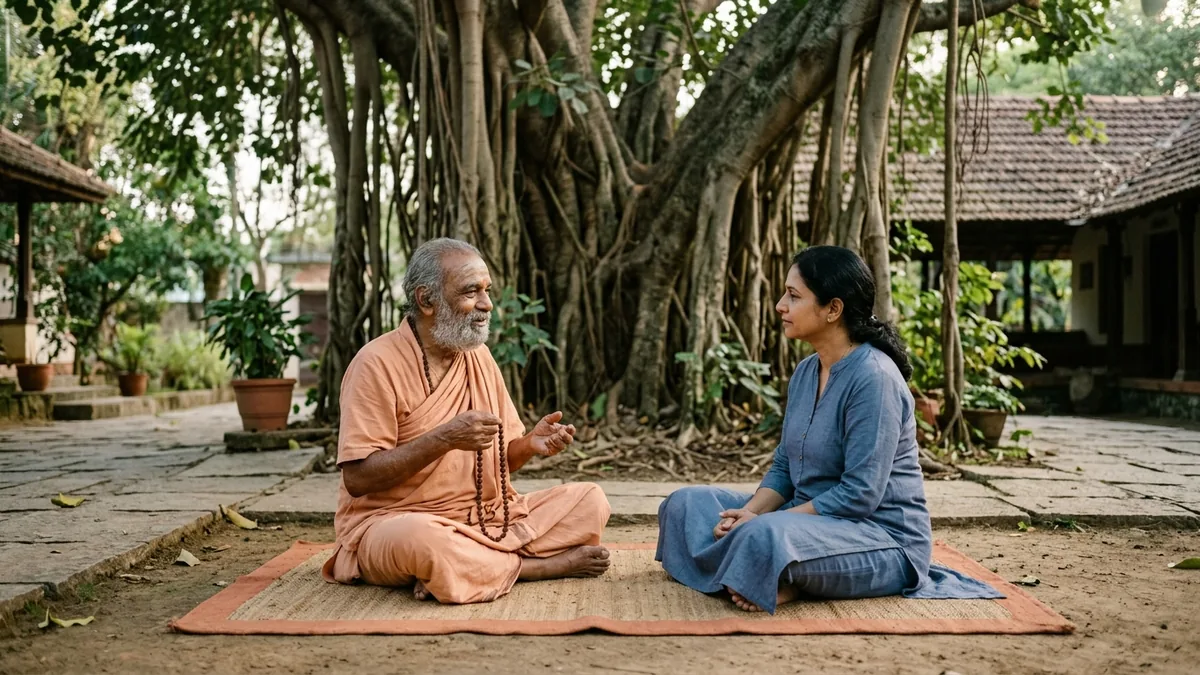
In Giving, You Shall Receive
What a millionaire sanyasi taught about karma, prosperity and why wealth begins with giving.
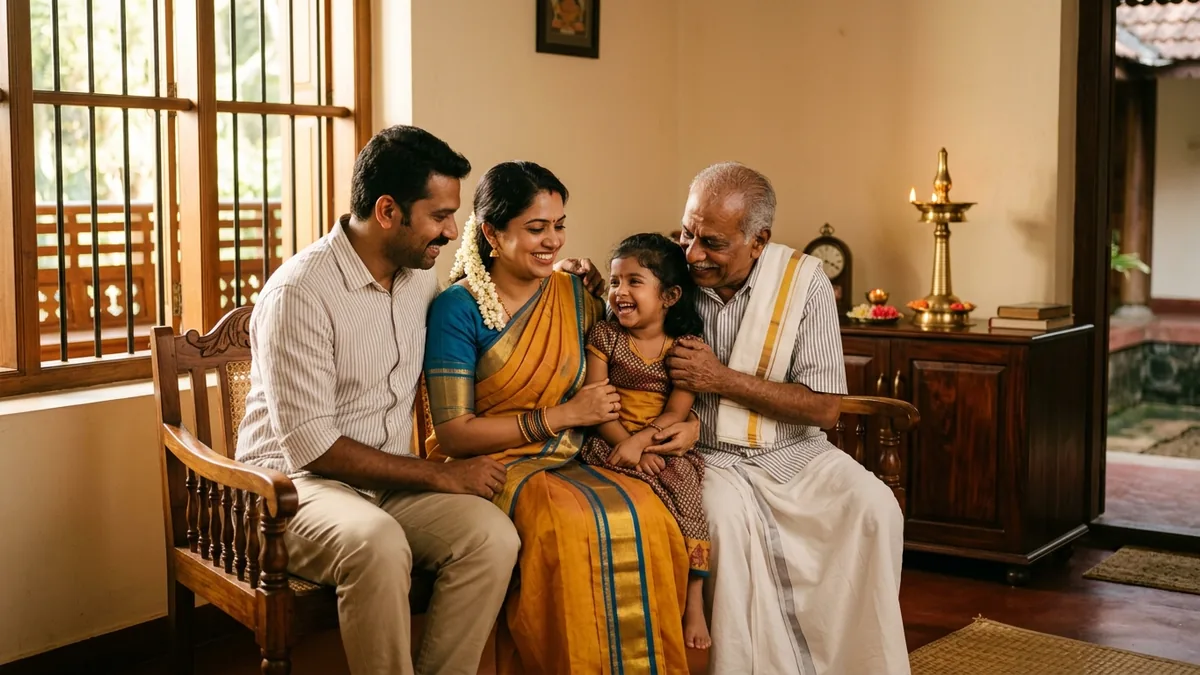
Life Events & Prosperity Cycle
Why weddings, children and celebrations open doors of abundance, and how to align with life's cycles.
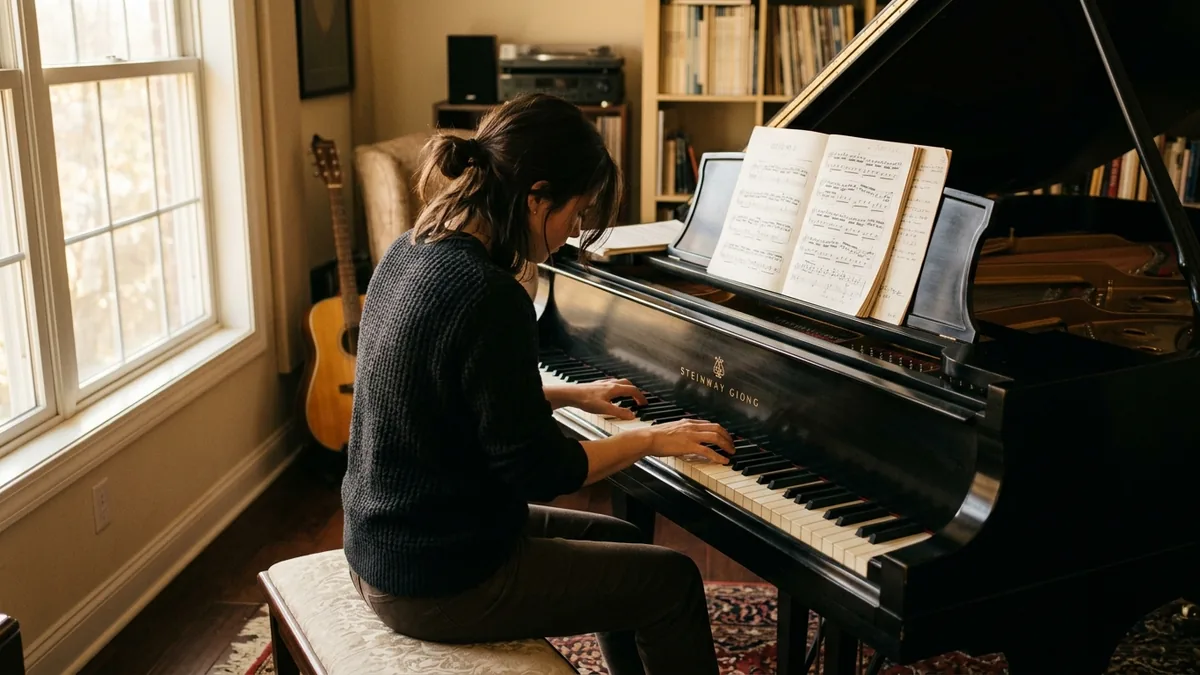
Mind of a Champion
The habits of mind that set champions like Ilaiyaraaja, Vadivelu, A.R. Rahman, Rajinikanth and Novak Djokovic apart.


