

Mahalaya Amavasya 2026: Date, Timings, Significance & Ancestral Rituals
Mahalaya Amavasya marks the sacred culmination of Pitru Paksha—the annual 16-day lunar period dedicated in Vedic tradition to honoring departed ancestors. Below is an informative guide on the 2026 date, Panchang timings, traditional spiritual meaning, and how to arrange ancestral poojas with authentic Vedic priests.
When Is Mahalaya Amavasya in 2026?
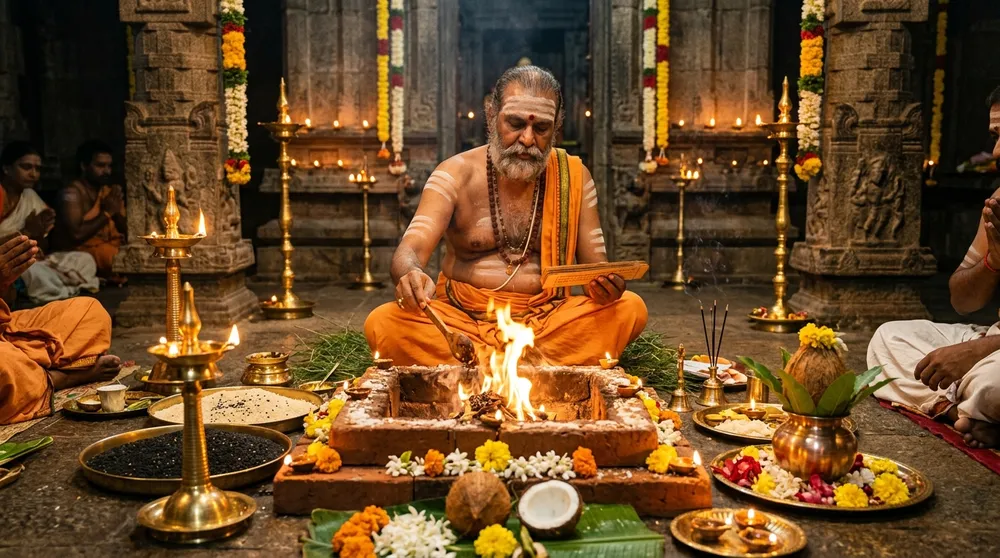
Mahalaya Amavasya falls on Saturday, 10 October 2026. Also known as Sarva Pitru Amavasya, it is the concluding New Moon day of the 16-day Pitru Paksha period. In Vedic tradition, devotees observe this day with prayers, Tarpanam, and sacred fire offerings (Thila Homam) to express gratitude to departed ancestors and seek their spiritual peace.
Mahalaya Amavasya 2026 Date & Panchang Timings
In Vedic astrology and traditional Panchang calculations, ancestral rites (Shraddha, Tarpanam, and Homam) are performed during Aparahna Kaal (afternoon period). Below are the reference timings for Chennai (IST):
| Panchang Parameter | Calculated Details (IST / Chennai Reference) |
|---|---|
| Primary Observance Date | Saturday, 10 October 2026 |
| Amavasya Tithi Begins | 09:35 PM on Friday, 9 October 2026 |
| Amavasya Tithi Ends | 09:19 PM on Saturday, 10 October 2026 |
| Aparahna Kaal (Ritual Window) | 11:45 AM to 03:30 PM (approximate afternoon window) |
| Location Note | Exact sunrise and Tithi transition times vary slightly depending on your geographical location and local Panchang. |
What Does Mahalaya Amavasya Mean?
The Sanskrit term Mahalaya is derived from Maha (great or grand) and Alaya (abode or gathering). In ancestral tradition, it signifies the "great assembly of departed souls." According to ancient Vedic Shastras, the subtle barriers between the physical realm and the ancestral plane (Pitru Loka) are believed to dissolve during this sacred time, allowing ancestors to receive prayers and offerings from their living descendants.
Why Is It Called Sarva Pitru Amavasya?
The word Sarva means "all" and Pitru means "ancestors." Unlike individual death anniversaries (Tithis) that honor specific family members, Sarva Pitru Amavasya is an all-inclusive, universal day of remembrance:
- Universal Ancestral Gratitude: Prayers are dedicated to all known and unknown departed souls across maternal and paternal lines.
- Unknown Death Dates: It is specifically designated for ancestors whose exact death dates or lunar Tithis were unrecorded or forgotten.
- Untimely Departed Souls: Devotees offer special prayers for souls who experienced premature or accidental departures.
Pitru Paksha, Pitru Rina and Pitru Dosha
Pitru Paksha spans 16 lunar days starting from Purnima (full moon) of the Bhadrapada month and concluding on Amavasya (new moon) of the Ashwina month. Mahalaya Amavasya serves as the final, most spiritually potent day of this fortnight.
In Vedic philosophy, every person is believed to carry Pitru Rina—a sacred moral obligation of gratitude to parents and forebears for the gift of life and lineage. Upholding ancestral remembrance rituals is seen as a way to fulfill this debt with reverence.
In astrological consultations, when specific combinations involving Rahu, Ketu, or Saturn afflict the Sun, Moon, or 9th House in a birth chart, astrologers may identify Pitru Dosha. Astrologer K.B. Gopalakrishnan emphasizes that not all life obstacles stem from Pitru Dosha; a comprehensive birth chart reading is essential to confirm astrological dynamics. When indicated, Mahalaya Amavasya is considered an auspicious occasion for traditional remedial rites such as Thila Homam.
Mahalaya Amavasya Ritual Packages
Select your preferred Mahalaya Amavasya ritual option below. All rituals are conducted by authentic Vedic priests at Swami Narayanan Temple with personalized Sankalpam in your Name, Gotram, and Nakshatram.
Mahalaya Amavasya Pooja
Sacred ancestral remembrance prayer ceremony with personalized family Sankalpam and Pitru Suktam recitations for ancestor blessings and peace.
Individual & Family Ancestral Remembrance
- ✓ Personalized Sankalpam (Name, Gotram, Nakshatram)
- ✓ Pitru Suktam & Vishnu Sahasranama Chanting
- ✓ Shodasha Upachara Ancestral Offerings
- ✓ Sarva Pitru Shanti Prayers
- ✓ Priest Blessings & Prayer Completion
Single Priest Thila Homam
Dedicated fire-sacrifice ritual conducted by a qualified Vedic priest with black sesame (Thila) offerings into Agni for Pitru Dosha Pariharam.
Dedicated Family Fire Ritual & Pitru Dosha Pariharam
- ✓ Dedicated Qualified Vedic Priest
- ✓ Detailed Lineage Sankalpam & Intentions
- ✓ Ganapathi Homam & Main Thila Fire Oblations
- ✓ Complete Poorna Ahuthi & Sacred Ashirvadam
- ✓ Online / Remote Participation Video Updates
Sankalpam Requirements & Remote Devotee Participation
Sathyaprema provides astrological consultation and birth chart analysis from Astrologer K.B. Gopalakrishnan. All sacred fire rituals and ancestral poojas are independently performed by learned Vedic priests at Swami Narayanan Temple.
Rituals are performed with individualized Sankalpam incorporating your Name, Gotram, Janma Nakshatram (Birth Star), and known Ancestral Names. For devotees residing outside Chennai or overseas (including NRIs in the USA, UK, Canada, Australia, UAE, and Singapore), the temple provides remote Sankalpam services with video and photo updates.
Need Astrological Guidance or Ready to Perform Pooja?
Need Astrological Verification?
Consult Astrologer K.B. Gopalakrishnan to analyze your birth chart and verify if ancestral remedies are recommended for your horoscope.
Consult AstrologerReady to Honour Your Ancestors?
Arrange personalized Mahalaya Amavasya Pooja or Thila Homam directly with authentic Vedic priests at Swami Narayanan Temple.
View Temple PortalFrequently Asked Questions About Mahalaya Amavasya 2026
Sathyaprema by Astrologer K.B. Gopalakrishnan offers authentic Vedic, Nadi, Prashna astrology consultations and remedies.
Copyright © sathyaprema designed by Jigitals.